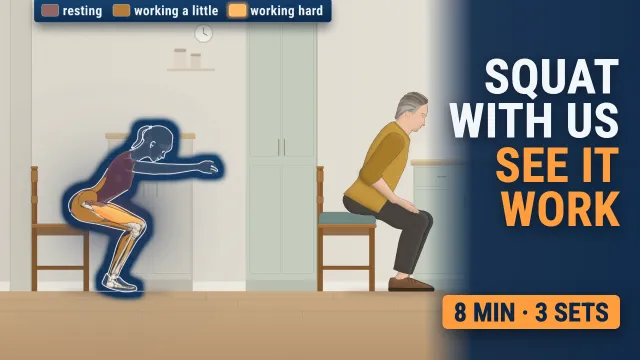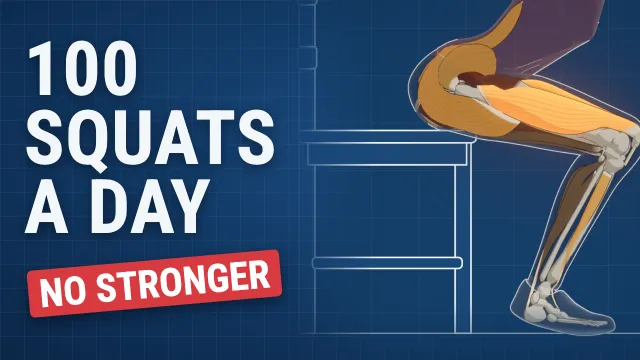
Film · 10:39 · Coming soon
What Squats Really Do for Your Body
This film shows which muscles a squat works, what happens inside a muscle from today to ten weeks from now, and what the research says made the difference.
Watch the filmFree printable plan
The chair squat plan, from the health guidelines and the studies in our film “What Squats Really Do for Your Body”. Two pages, to print in A4 or US Letter.
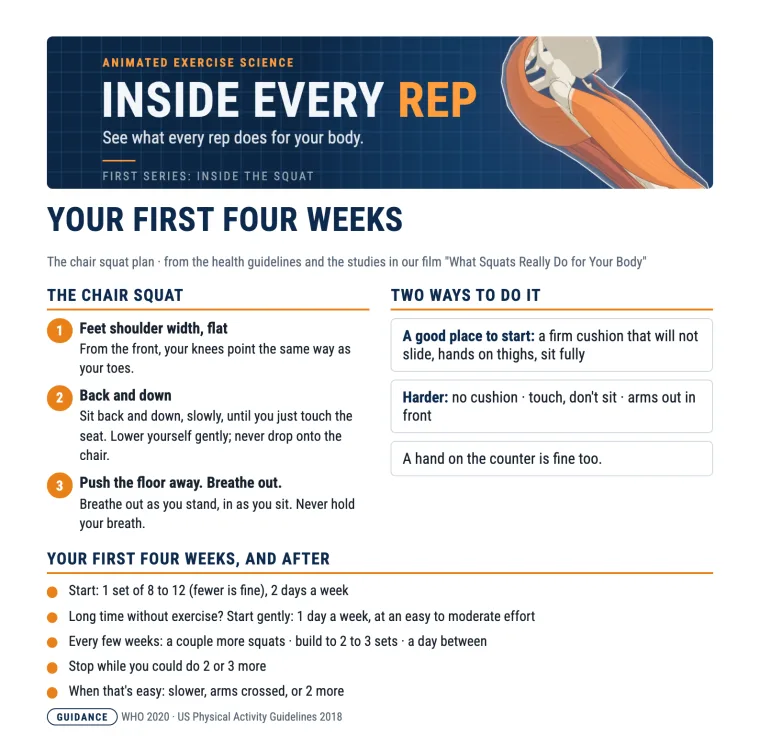
Page 1 of 2. Page 2 is “Staying safe”.
PDF, 2 pages
Free, with nothing to fill in. Privacy notice
From the front, your knees point the same way as your toes.
Sit back and down, slowly, until you just touch the seat. Lower yourself gently; never drop onto the chair.
Breathe out as you stand, in as you sit. Never hold your breath.
Guidance WHO 2020 · US Physical Activity Guidelines 2018
Weeks 1 to 4, Monday to Sunday, with a box for the squats in a set. Ring the days you do your squats, with a day between. Write how many you did in a set.
Read this before your first squat.
Use a solid chair with no wheels, one that will not slip, with its back against a wall. Keep something sturdy within reach. Clear the floor, and wear shoes that grip.
Ask your own doctor first if you have: a heart condition · high blood pressure, even if controlled · diabetes · a pacemaker or defibrillator · a past stroke · a joint replacement · a bone, joint or muscle problem · a pregnancy · a fall in the past twelve months, or unsteadiness · any other medical condition.
Very high blood pressure that is not under control, or a heart condition that is not stable: not now. See your doctor.
Stop. Pain · Dizziness or light-headedness · A racing or pounding heart · Unusual breathlessness · Chest pain.
Sit down. Stop for today. See a doctor before exercising again.
Chest pain, real trouble breathing, or fainting: call your emergency number (999 UK · 911 US · 112 EU).
Knee: stop and get medical advice straight away if it locks · gives way · swells badly or changes shape · clicks painfully · hurts badly · is red or hot and you feel feverish · or if you can't move it or put weight on it. Painless clicking is normal (NHS).
After a hip or knee replacement: follow your own surgeon's and physiotherapist's limits.
Stand up slowly, with a hand near something solid. If you ever feel light-headed when you stand, tell your doctor.
General education, not medical advice. We cannot advise on anyone's own health; for that, please ask your doctor. Read all the safety notes
Every study in the film is listed on its page: What Squats Really Do for Your Body.
See what the chair squat does inside your body, then do it with us at home.
Film · 10:39 · Coming soon
This film shows which muscles a squat works, what happens inside a muscle from today to ten weeks from now, and what the research says made the difference.
Watch the filmFollow-along · 8:15 · Coming soon
Three sets of up to ten chair squats in real time, with a rep counter, timed rests, and a look inside the working muscle.
Watch and follow along